Renewal of the College needs to evolve new mechanisms that are compatible with the life-styles of ordinary normal common-or-garden psychiatrists. And MOPS groups and Auspsyc are the closest we have so far.
We should build on the strengths.
Right now we have the elections fast approaching. I have always held that direct elections and democracy are necessary, but not likely to be sufficient. The new generation of elected officials need to be chosen and encouraged to carry into the College a new spirit of accountability, participation and responsiveness to the fellows.
One suggestion I have is that we in Auspsyc should obtain the names and email addresses of all the candidates and invite them to join us, and participate in a sort of online community meeting. We could ask them what their vision for the College is. We could quiz them on their position on various topics. This would help them present their candidacies, and help us decide who we want to vote for.
Julian, as moderator, would you like to approach John Chalk to ask for the list of candidates?
Cheers
David
| Elections |
|
| Posted By: |
|
Thu Apr 4, 2013 11:33 am | |
|
|
|
|
Hi list,
I'm a bit surprised there hasn't been more discussion about who we should vote for. Voting closes on April 10th, next Wednesday.
http://tinyurl.com/dyy3le2
Anyone have any inside goss, or strong opinions about any of the candidates? Who do you think is best to carry through the spirit of democratic change that we voted for?
Cheers
David |
| College elections |
|
| Posted By: |
|
Fri Apr 5, 2013 8:52 am | |
|
|
|
|
Dear Philip, David, Kym and Malcolm,
I am writing to each of you as the four candidates for the forthcoming College elections.
As I expect you know, there are some email lists for psychiatrists, including Auspsyc and the Private Practitioners Network. Auspsyc has 311 members, mostly psychiatrists. It is independent of the College.
http://health.groups.yahoo.com/group/auspsyc/
The PPN has 55 members. http://au.groups.yahoo.com/group/ppn_ranzcp/
Each of these groups played an active role in promoting the change in the constitution of the College to having direct elections. Many of us are hoping that the change will be a success.
Recently there has been some discussion, on Auspsyc in particular, about how little we know about what each of you candidates stand for. Here are some sample comments.
> The personal statements on the
> College website all read much the same, and I find it hard to get a feel for
> what issues and beliefs separate one candidate from another.
> I may be wrong but seem to recall that candidates were invited to present
> more specific views and policies to auspsyc, which has not materialized. It
> is of course not too late to do so.
____________________
> I felt exactly the same. I have no idea who the others are and their
> statements are so unspecific that it is impossible to make a decision in
> particular that we have to make at least 5 choices, otherwise no vote. > Apart from Phillip I have not heard or seen anything, nor have I received any
> emails. I find this very weird. Any colleague I have asked here in SA had
> replied that they are not interested in it.
I wonder whether you would like to write to us and let us know what you would like to do as president if you were elected. In particular, how do you think the change to direct elections can be used to improve the engagement between fellows and the College.
If you replied to me, I would copy your response to the two lists. Alternatively you could write direct to the two moderators.
Auspsyc: Dr Julian Parmegiani. jparmegi@...
PPN: Dr Gary Galambos. ppn@...
Best wishes
David Straton
From: Malcolm John Hopwood <mhopwood@...>
Subject: RE: College elections
Date: 5 April 2013 9:08:02 AM AEST
To: David Straton <davestraton@...>, Philip Morris <pmorris@...>, David Alcorn <David.Alcorn2@...>, Kym Jenkins <kym_rfm@...>
Dear David
Hi and thank you for the contact. I obviously don’t know about everyone else but I hadn’t received such a request before. Our college is now a quite large one and it may well be that some Fellows therefore feel they don’t know the candidates well and this may well be worth reflecting on for the future for whomsoever ends up on the Board. Never the less, at this time the College has set up some specific rules around campaigning that I don’t want to infringe. I therefore feel the best course is to refer the request to the Governance section of the College who, as I understand it, are responsible for jurisdiction of the elections for them to say what they think first. I trust you understand this approach.
Mal Hopwood
|
| Re: College elections |
|
| Posted By: |
|
Fri Apr 5, 2013 11:43 am | |
|
|
|
|
Oh dear!
Sound of 'can of worms' opening!
What I thought was a simple request has exposed some serious restraints on campaigning by the candidates, set by the Corporate Governance and Risk Committee.
Two of the candidates have got back to me so far, saying they are afraid that to answer my question might infringe the rules. This at least explains the deathly silence.
The rules are on the College website here. http://tinyurl.com/chm68rr
They include:
f) All candidates may undertake election campaigning. However, the only methods of campaigning that will be allowed include:
• Publishing of a personal statement in the College’s Psych-e Bulletin (max 200 words)
• Publishing of a personal statement in College Branch/New Zealand National Committee newsletters (max 200 words)
• Informal conversations at College events and with College members
• Informal emails amongst College members g) Any election campaigning undertaken by a candidate and/or their supporter(s) that falls outside the above campaigning methods will not be allowed. It is the responsibility of the candidate to ensure that their supporter(s) comply with these rules.
h) Nominees will be eligible to provide Supporting Statements in accordance with Board Election Regulations.
i) No candidates will be provided access by College members or staff, to email or contact details for Fellows to use in election campaigning.
j) Candidates, College Members or supporters must not use the College’s resources or funds in canvassing support or promoting or opposing the election of any nominee, excepting those resources indentified in item f).
k) The College’s logo must not be used on any materials for campaign purposes, including a candidate’s website (if any).
l) Any campaigning that is deemed by the Board, Corporate Governance and Risk Committee (CGRC) or Company Secretary to be dishonest, to bring the College into disrepute or to discredit another candidate, will not be allowed.
m) Any alleged breach of these Guidelines will initially be referred to and investigated as appropriate by the Company Secretary for matters of fact. Following investigation, the Company Secretary, may recommend to the Board a course(s) of action.
n) The College reserves the right to disqualify a candidate.
o) Any questions regarding campaigning for elections to the Board or the interpretation of this Guideline or the Board Election Regulations should be directed to the Company Secretary or Governance Manager.
I, and the two candidates who have written so far, are seeking clarification from the College. Hopefully some sort of discussion with the list will become possible.
Cheers
David
From: "Peters, Andrew" <Andrew.Peters@...>
Subject: FW: College election rules
Date: 5 April 2013 11:23:00 AM AEST
To: <davestraton@...>
Cc: "Hopwood, Malcolm" <mhopwood@...>, <david_alcorn@...>, <pmorris@...>, "Jenkins, Kym" <kym_rfm@...>, "Hain, Louise" <Louise.Hain@...>
Dear Dr Straton
Thank you for your email which has been forwarded to me by Louise Hain in my capacity as Company Secretary and which I have discussed with the Chair, Governance and Risk Committee.
The following clause from the College’s Guideline in relation to Board Elections is relevant regarding campaign activities (attached).
f) All candidates may undertake election campaigning. However, the only methods of campaigning that will be allowed include:
Publishing of a personal statement in the College’s Psych-e Bulletin (max 200 words)
Publishing of a personal statement in College Branch newsletters (max 200 words)
Informal conversations at College events and with College members
Informal emails amongst College members
In accordance with the above Clause f), the publishing of personal statements should be restricted to the documents already provided by the candidates and published by the College.
Regards
Andrew
Andrew C Peters
Chief Executive Officer and Company Secretary
The Royal Australian and New Zealand College of Psychiatrists
|
| Re: College election rules |
|
| Posted By: |
|
Fri Apr 5, 2013 1:15 pm | |
|
|
|
|
|
Hi Andrew,
Thankyou for replying.
Please can you clarify, would responding to members of the Auspsyc list be permissible as being 'informal emails amongst College members'?
I would argue that it should be permissible. As several people have commented, we know little about those candidates that we don't know personally. The pro-forma personal statements have been described as: 'The personal statements on the
College website all read much the same', and 'their statements are so unspecific that it is impossible to make a decision'.
Whilst I sympathize with the College trying to keep the process under some sensible level of control, the degree of constraint and inhibition the candidates are experiencing is quite unprecedented in the democratic world.
As voters, we are in a position equivalent to being judges at a beauty contest at which all the contestants are obliged to wear paper bags over their heads.
Please would you discuss again with the Chair of the Governance and Risk Committee, and ask that we be permitted to question the candidates.
The change of the Constitution to include direct elections is an opportunity to increase the legitimacy of the President and Directors in the minds of the fellows. It will be a tragedy if the process is contaminated by voters feeling that their ability to exercise their critical judgement about the candidates was being restricted unreasonably.
Yours sincerely,
David Straton
|
| Lobbying the Governance and Risk Committee |
|
| Posted By: |
|
Fri Apr 5, 2013 5:48 pm | |
|
|
|
|
Hi lists,
I have just received this:
Dear Dr Straton
Following discussions with members of the Governance and Risk Committee (GRC), it is our belief that the intention of the election campaign guidelines are that emails to and from candidates regarding the ‘campaign’ should not be via an established group or organisation but rather individual or small informal discussions.
It is suggested that the Auspsyc list is an example of an established group.
I would suggest that candidates could place their 200 word personal statements (as presented to the College) together with an email or contact number, if they choose, inviting Auspsyc members to contact them if they wish to seek further information on their candidacy.
Regards
Andrew
Andrew C Peters
Chief Executive Officer and Company Secretary
The Royal Australian and New Zealand College of Psychiatrists
I find this bizarre. In essence, what Andrew recommends is exactly what I did; write to the four candidates to seek further information on their candidacy. Two have answered, but in fear that they might be breaching the rules, they have not consented to me copying their replies to the lists. And it seems that they are right. The rules are so restrictive that it appears that I cannot tell you what they said to me. If you want to ask the candidates something, you must write individually, and keep the reply secret from the rest of us.
This is an unreasonable restriction on our ability, as voters, to exercise scrutiny of the candidates that we are expected to select.
The following people are on the GRC.
Governance and Risk Committee
Dr Scott Harden (Chair), scott@...
Dr Ness McVie, reception@...
Dr Nicholas O'Connor, noconnor@...
Dr Murray Patton, murray.patton@...
You might want to tell the committee members what you think.
Yours
David
|
| Open letter to candidates in the College election |
|
| Posted By: |
|
Fri Apr 5, 2013 11:33 pm | |
|
|
|
|
Dear Candidates in the College election,
I am trying to decide which of you to vote for.
I have tried to use the Auspsyc and PPN email lists as venues for a sort of 'town hall' meeting at which you might have been able to address a large group of psychiatrists and answer questions, but that has been ruled out.
We are, however, to be permitted to write to each of you individually and for you to respond to individuals by email.
I perceive two different dimensions, along which I imagine each candidate will fall.
1) The Wind-of-Change
2) The balancing of a fragile coalition.
1) The Wind-of-Change.
It is unlikely to be news to any of you that there has been substantial disgruntlement in the College about the way it has been led in the last few years. On Auspsyc we held a poll after two presidents had resigned. One option was that we should trust the Executive to handle the problem. Only 2% agreed.
An advisory panel produced a report after investigating the resignation of the presidents. It was suppressed.
$362,000 was paid out to an ex-employee of the College without adequate explanation.
In February 2011, 136 fellows signed a petition asking for a Members Requisition General Meeting. It was refused.
There have been many other examples of the leadership of the College behaving in a way that many fellows have perceived as arrogant, high-handed, anal, and insufficiently transparent and accountable.
This, more than anything else, has been the driving force behind the push for direct elections, a move supported eventually by 79% in the May poll, with 93% endorsing the democratic change to the Constitution in August 2012.
This is a substantial Wind-of-Change in the direction of open-ness, accountability, and democracy.
My question for you is: Where on this continuum do you lie? Where do you think the current College leadership lies?
Anality = 0, Enthusiastic Wind-of-Change = 10
2) The Balancing of a Fragile Coalition
I wrote the following as part of a debate on Auspsyc. I should be interested in whether you agree or not with its sentiment, as a basis for creating a new and cohesive climate in the College.
______________________________________________
Psychiatry is different to other medical specialties. Surgeons vary by area of anatomy: bums, boobs, bones, etc. Physicians do hormones, hearts or heads, etc. But they mostly agree about basic principles.
But within psychiatry we have a much wider spread of issues. Some regard others with contempt. Some psychotherapists pour scorn on psychopharmacology. Some regard psychoanalysis as little better than scientology.
There is a huge gap between private and public psychiatry.
There is no equivalent diversity in other areas of medicine.
On top of that, many people attracted to careers in psychiatry also care deeply about other areas of life, such as boat people, religion, Israel, Palestine, homosexual marriage, terrorists relatives, etc, etc.
All of this boils down to a serious challenge. The truth is we have a very fragile coalition. It is too fragile to contain some of the things that we disagree about.
After the revolution, the College must somehow act in ways that respect that fragility of our coalition, yet act to improve our public profile, our political effectiveness, and increase our political capital.
And we had better accept the fact that at present it is woeful!
All over the 'Better Access' program is written the political judgements: 'Mental Health is a serious problem'. 'Lets spend billions on it.' 'How can we keep psychiatrists out of it?'
In my opinion, the Government perceived us as being a bunch of idiots preoccupied with hassling them about boat people, or pushing for a model of therapy which featured highly subsidized psychiatrists seeing one or two new patients a year.
'Whatever the problem, psychiatrists are not the answer'.
It was a disaster. We have been seriously peripheralized.
The dilemma we face is how to agree on core subjects that unite us, and how to avoid issues that divide us, and also diminish our political capital. And a mantra of polite tolerant inclusiveness is not going to do that. Over-inclusiveness is a serious danger. It will lead to more splitting, and ineffectiveness in restoring our brand.
IMHO, the topics that unite us include:
- Cost-effective mental health care for the community.
- Evidence-based medicine.
- Suicide prevention.
- High-quality training for psychiatric trainees.
- Public respect for the profession of psychiatry.
- The role of psychiatrists as leaders and integrators of other mental health
- professions.
- Good remuneration for psychiatrists.
There are many topics that divide us:
- Boat people
- Homosexual marriage
- Psychopharmacology vs psychotherapy
- Item 319
- Israel/Palestine
- Iraq, Afghanistan
- Aboriginal rights
By and large, the issues that unite us, if presented well, will increase our political capital. The issues that divide us, if publicised noisily, tend to diminish our political capital.
Some would argue that we should be tolerant, inclusive, mutually respectful, blah, blah.
In my view, we have been too tolerant, for too long. There has not been enough opposition and criticism. If we don't criticize and denounce the influences that have led to our peripheralization, the processes will continue.
I hope that the new democratic beginning for the College will lead to increased focus and effectiveness, and less over-inclusiveness. Yours
David Straton
|
| Re: College election rules |
|
| Posted By: |
|
Sat Apr 6, 2013 7:33 pm | |
|
|
|
|
Dear Andrew, Scott and other members of the CGRC.
It is very disappointing that you have interpreted the College Guidelines for Board Elections in the way that you have.
We are at a critical point in the College's history, with 93% of voters choosing a new Constitution with direct elections for the President and Directors. This after a 16 year campaign. Many obstacles were put in the way, with one argument being repeatedly made by the opponents of democracy, 'that Fellows would not know the candidates well enough to make an informed choice'.
The CGRC is responsible for ensuring that the elections are free and fair.
The College’s Guideline in relation to Board Elections ( GUIDE OPCEO Board Elections – Campaign Activities) includes:
'The purpose of this Guideline is to ensure that:
Fellows have sufficient information to make informed choices in elections.'
There is a widespread feeling on the Auspsyc and PPN lists that this has not occurred. We have been issued with standardised and circumscribed information packs, which have been inadequate for us to differentiate between the candidates.
Please will you explain to me and other fellows exactly what risk you are trying to protect us from by prohibiting us from questioning the candidates and publishing their responses?
I urge you to immediately reverse your decision, in time for voters to take into account information they might thus acquire before voting closes.
Yours sincerely,
David Straton |
| Re: [auspsyc] Low voter participation |
|
| Posted By: |
|
Thu Apr 11, 2013 8:16 am | |
|
|
|
|
Hi Renate,
I have read the Constitution http://tinyurl.com/ckhvja2 , and the election
related material that I can find.
http://tinyurl.com/dyy3le2
http://tinyurl.com/chm68rr
There is reference in the latter to 'Board Election Regulations', but there is no such animal clearly named that I can find by searching the College website. http://tinyurl.com/cxuzmr2
I looked through some of the near-misses. I can see no sign that the validity of the election result depends on a minimum voter turn-out.
I think Maria was making the point that the legitimacy of the new Directors and President-elect would be increased by a good turnout.
I think we have to accept that there were significant forces that didn't want the messiness of direct-elections, and ran them with gritted teeth. The setting for 'apathetogenesis' was set pretty high, with absurd restrictions on campaigning.
Hopefully the incoming cohort will have some rudimentary awareness of the need to be sensitive to Fellows opinions, and of the possibility of being criticized and/or ridiculed if they fail to do so. I'm hoping that the democratic process will gradually help to produce a healthier and less apathetic culture in the College.
Best wishes
David |
| Re: [auspsyc] Board Election Results - disqualification |
|
| Posted By: |
|
Sat Apr 20, 2013 2:13 pm | |
|
|
|
|
|
It is so sad.
This should have been a time for celebration; a time for trumpets, balloons and streamers. A time to congratulate Maria Tomasic for managing the reform of the College constitution.
A time to welcome joyously the new President-elect, and the newly elected directors, as being authentically elected in a free and fair election. Carrying the legitimacy of directly elected officials, with a credibility which has been lacking for a long time.
Instead, the election process has been flawed, neither free nor fair.
And there are victims to spare.
The Members of General Council will carry the odium of making the decision to disqualify Philip, after the vote was completed. In the absence of further information, it seems probable that Philip got enough votes to win a place, but that the existing power group didn't like that and therefore disqualified him. (If he hadn't got enough votes, why bother to disqualify him?)
The CEO and the members of the Corporate Governance and Risk Committee will carry the odium of affirming the absurdly restrictive regulations on campaigning, which prevented the candidates from answering my question and allowing their answers to be published on Auspsyc and PPN.
The restrictions were:
f) All candidates may undertake election campaigning. However, the only methods of campaigning that will be allowed include:
Publishing of a personal statement in the College's Psych-e Bulletin (max 200 words)
Publishing of a personal statement in College Branch newsletters (max 200 words)
Informal conversations at College events and with College members
Informal emails amongst College members
My question to the candidates was:
"I wonder whether you would like to write to us and let us know what you would like to do as president if you were elected. In particular, how do you think the change to direct elections can be used to improve the engagement between fellows and the College."
Not, I should have thought, an inflammatory or inappropriate question. But one that was ruled could not be answered and republished on Auspsyc.
I don't know who was responsible for writing and officially confirming the College Guidelines for Board Elections, but if and when their identity becomes known, they will tragically risk public ridicule.
Another category of victim of this business, is, of course, the newly elected President-elect and directors. At a moment when they might reasonably have hoped for unqualified welcome and legitimacy, they have instead assumed their positions with some public doubt about whether they were genuinely the choice of the electorate. How unfair for them.
Finally, I commiserate with Philip, who has likely been robbed of one of the positions for which he stood.
Such a shame!
With so many losers from this contaminated process, can anyone see a winner?
I hope that the incoming President and board will immediately announce that future elections will be conducted in a less restrictive fashion, and act to distance themselves from this shameful affair.
David
|
| Re: [auspsyc] Board Election Results - disqualification |
|
| Posted By: |
|
Sun Apr 21, 2013 7:43 am | |
|
|
|
|
I have set up an Auspsyc poll to collect numbers of people who endorse particular statements here.
I hope lots of people vote, including those who support the College's management of the elections, so there can be some objective measure of the strength of opinion on the issue.
Feedback on the recent College elections for President-elect and Board Directors.
You can vote for as many options as you wish.
- I support the way the College managed the elections.
- I deplore the way the College mis-managed the elections
- I deplore the excessively restrictive rules on campaigning by candidates.
- I deplore the disqualification of a candidate after the vote had been taken.
- I believe that the members of General Council and the Corporate Governance and Risk Committee should resign for mismanaging the election.
To vote, please visit the following web page:
http://groups.yahoo.com/group/auspsyc/surveys?id=13176899
Note that you must be a Yahoo member to vote. Some members of Auspsyc are not Yahoo members. They could email me with their votes, and I will add them to the pile.
David |
| Poll closed |
|
| Posted By: |
|
Tue Apr 23, 2013 5:47 am | |
|
|
|
|
Hi list,
I have closed the poll. 20 people voted on the website.
The results from the web can be seen here.
http://health.groups.yahoo.com/group/auspsyc/surveys?id=13176899
In addition there were five people who emailed me with their votes. All five of them voted the same:
- I deplore the way the College mis-managed the elections,
- I deplore the excessively restrictive rules on campaigning by candidates,
- I deplore the disqualification of a candidate after the vote had been taken,
Thus the total results were: http://tinyurl.com/caatopy
Choices and Results
| |
Votes |
% |
| I deplore the way the College mis-managed the elections. |
21 |
84% |
| I deplore the excessively restrictive rules on campaigning by candidates. |
23 |
92% |
| I deplore the disqualification of a candidate after the vote had been taken. |
24 |
96% |
| I believe that the members of General Council and the Corporate Governance and Risk Committee should resign for mismanaging the election. |
8 |
32% |
| I support the way the College managed the elections. |
1 |
4% |
David
|
|
| Seizing disgrace from the jaws of triumph |
|
| Posted By: |
|
Sat Apr 27, 2013 2:12 pm | |
|
|
|
|
Dear list,
I wonder if anyone else is as gob-smacked as I am.
I have just read the extraordinary letter from John Chalk trying to justify the handling of the College elections.
Remember, when you read it, that he had been told that the Auspsyc poll had shown these responses:
Choices and Results
| |
Votes |
% |
| I deplore the way the College mis-managed the elections. |
21 |
84% |
| I deplore the excessively restrictive rules on campaigning by candidates. |
23 |
92% |
| I deplore the disqualification of a candidate after the vote had been taken. |
24 |
96% |
| I believe that the members of General Council and the Corporate Governance and Risk Committee should resign for mismanaging the election. |
8 |
32% |
| I support the way the College managed the elections. |
1 |
4% |
One might have thought that, when faced with the evidence that 92% of people thought that the rules on campaigning were excessively restrictive, that a more robust argument might have been indicated than to declaim airily that:
"The College also issued Guidelines for Board Election campaign activities to ensure that all candidates that took part in the election were treated fairly and equally, and that the elections were conducted in a manner befitting the College."
"It was the College’s objective to ensure that the elections were conducted in a fair and transparent manner and that a spirit of collegiality was maintained."
"A manner befitting the College."
"A spirit of collegiality."
Does anyone think that such expressions address the problem adequately?
Does anyone think that Philip's disqualification fits the description "fair and transparent manner?"
96% of voters apparently don't.
One of the things that astonishes me is that it appears that the luminaries of our College can have reach the dizzy heights of being the flower of our profession without having apparently absorbed the meme of democratic election.
It is surely one of the central memes of Western Civilisation, and beyond, encompassing the whole democratic world. Most of them have grown up in a country that practises elections. The concept has been around for centuries, and has been an issue in the major wars of the twentieth century.
Yet, on the evidence before us, our leaders haven't somehow 'got it'.
Elections are a time for the contest of ideas. A time when narcissists strut their stuff. When posters are stuck on walls where they are not allowed. When texta moustaches are painted on womens' photos. When candidates call each other names, and make outrageous promises and debunk each other. When there are arguments about money and budgets and so on.
They are messy. And noisy. They involve conflict of ideas and personalities.
And the electorate can observe, and heckle, and make judgements about the respective abilities, credibility and programs of the competing candidates.
We can ask questions, like: 'If we elect you, do you promise to stay in the job for the full term?'
Or 'If, hypothetically, a relationship with one of the College employees went pear-shaped, would you promise not to send us the bill?'
A central idea is that elections must be FREE and FAIR.
The College mentions 'Fair' in passing. No mention of 'Free'.
I'm pretty sure most school-kids would understand that retrospectively disqualifying a candidate after the vote had been completed, without due process, doesn't fit the word 'Fair'. 96% of voters on Auspsyc agree.
And that restricting candidates to 200 approved words and one-to-one emails doesn't fit the word 'Free'. 92% of voters on Auspsyc agree.
Fairness and equality is not adequately achieved by gagging everyone equally.
A manner befitting the College surely means a manner that most College members would endorse. Only 4% did.
A spirit of collegiality surely should not exclude a bit of honest and open debate.
I understand that there is currently a paradigm shift going on, and that the old guard might have a different idea of what "a manner befitting the College" might mean when compared to that of the democratic reformers. But I never imagined that their vision would be so restricted and over-controlled.
Try this as a metaphor.
We all turn up at the Colosseum expecting a election spectacle with gladiators, Christians and lions. We hope to celebrate the arrival of direct elections for a psychiatric College, the culmination of a sixteen year campaign, finally endorsed by 93% of us.
But the priesthood, on the verge of being pensioned off as relics of the old regime, decide to mark the occasion with something they think is a manner befitting a psychiatric College.
Out into the arena are wheeled eleven trolleys with eleven candidates, gagged and strapped down in strait-jackets.
One of them splutters and wriggles.
'Off with his head!' says the high priest.
Its a disgrace.
David
|
| Re: [auspsyc] Seizing disgrace from the jaws of triumph |
|
| Posted By: |
|
Sun Apr 28, 2013 7:14 pm | |
|
|
|
|
|
Hi Frank,
25 people responded between 20th April and the closure of the poll on 22nd April.
There are 312 members of Auspsyc.
There are 3,600 psychiatrists in the RANZCP.
Polls on Auspsyc are routinely discounted by those so motivated on the grounds that the numbers are inadequate to be reliable.
A previous Auspsyc poll in December 2010 had a result of 89% of voters wanted direct elections of College Executive members. This result was poo-pooed. After much kicking and screaming, the College conducted a fellowship-wide poll in April 2012 with the result of 79% being in favour of direct elections. With the later vote of 93% for the constitution change that included direct elections, the original Auspsyc poll can be seen in retrospective to have been pretty accurate.
The numbers are so overwhelming in the present poll, that I think we can be reasonably confident that a majority of fellows feel the way our poll indicates, even if the figures are not completely valid because the size of the sample is small, or the membership of Auspsyc may be atypical of fellows generally.
What do you think?
David
On 28/04/2013, at 6:25 PM, Frank New <frankjnew@...> wrote:
Dear David,
I would appreciate your clarification.
I understood the "96% of voters apparently don't" are voters in the Auspsyc poll.
What does this number represent in terms of the proportion of RANZCP Fellows?
Regards,
Frank New
|
| Re: [auspsyc] Resignation |
|
| Posted By: |
|
Tue Apr 30, 2013 9:05 am | |
|
|
|
|
|
Dear Yvonne and Michael,
Thankyou both for telling us about your resignations.
One of the things I have found most dispiriting about the extreme polarisation in the College has been the apparent unanimity of the decisions made by Executive, the General Council, and the Corporate Governance and Risk Committee, in contrast to the figures in the mid 90%s in the opinions of the members of Auspsyc, all in exactly the opposite direction.
It saddens, but does not surprise me, that some senior members of an organisation like the College should sometimes exercise poor judgement. But as it has been presented to us time and again, these judgements have been unanimous. For some of them to be stupid is one thing. For all of them to be stupid has been unbelievable and deeply shocking.
By distancing yourselves from this shemozzle, you have at least reduced that perception.
Thankyou.
David
|
| Latest results of election count |
|
| Posted By: |
|
Fri May 3, 2013 6:58 pm | |
|
|
|
|
Hi list,
You will have received the latest letter from John Chalk, with links to extensive detail about the election.
Mal Hopwood won the president-elect position with 468 votes after distributions. Philip Morris came second with 279.
With Mal removed from the ballot for the five director positions, the results were, in this order:
1) Philip Morris
2) Kim Jenkins
3) Victor Storm
4) Margaret Aimer
5) Peter Jenkins
http://tinyurl.com/cczleb7
Philip was then disqualified.
John's letter does answer many questions.
http://tinyurl.com/d8hmbxo
It fails to acknowledge that the original rules were excessively restrictive.
The rules are on the College website here. http://tinyurl.com/chm68rr
f) All candidates may undertake election campaigning. However, the only methods of campaigning that will be allowed include:
- Publishing of a personal statement in the College’s Psych-e Bulletin (max 200 words)
- Publishing of a personal statement in College Branch/New Zealand National Committee newsletters (max 200 words)
- Informal conversations at College events and with College members
- Informal emails amongst College members
One outcome I hope for is that these rules are relaxed to a more reasonable level for future elections.
David |
| re: College election rules |
|
| Posted By: |
|
Fri May 3, 2013 8:56 pm | |
|
|
|
|
|
It was made clear to me by Andrew Peters (and quoting the Chair and members of the Corporate Governance and Risk Committee) that the candidates could communicate with me individually, but that I could not republish their replies on Auspsyc.
The rules were quite bizarre and inappropriate. They certainly failed to meet the expectation that the elections would be 'free and fair'.
John Chalk's letter tries to justify the rules:
"The Guideline for Board Election campaign activities was developed conservatively to ensure that all candidates that took part in the election were treated fairly, equally and that the elections were conducted in a manner befitting the College.
From the outset, all candidates were informed of the Guideline and the College’s expectations that they present themselves to the Fellowship in a manner which represents the collegiate spirit of the election, and respect their fellow candidates by undertaking election campaigning in a fair and equitable manner. Candidates who wish to represent the Membership of the College in its highest level of governance would be expected to conduct themselves in a manner commensurate with the dignity of the office they aspire to hold."
A lot of talk of 'fair'. None of 'free'.
'Conservatively', 'in a manner befitting the College', 'commensurate with the dignity', etc.
I hope, when we have completed this democratic reform, that 'a manner befitting the College' will mean something a lot less constipated.
David
|
| Reclaiming the College |
|
| Posted By: |
|
Tue May 7, 2013 10:17 am | |
|
|
|
|
Well done whoever did the Downfall parody. (No, it wasn't me).
If it had been mine, I would have had the girl trying to comfort the other tearful girl say something more like: 'Don't worry, we'll get a huge payout.'
I'm in favour of humour and satire. Our goal should be to change the culture of the College, not merely change the rules. After the suppressed report into the two presidents resigned in 2010, we ran a poll on Auspsyc called 'Reclaiming the College'.
http://health.groups.yahoo.com/group/auspsyc/surveys?id=13053312
I think 'Reclaiming the College' is a good slogan to express what I think many of us on Auspsyc are trying to achieve.
Direct elections were a difficult but important step, necessary but probably not sufficient. I, like many others, am disgusted that the the elections were so badly mismanaged, and that the opponents of democratic change couldn't find it in them to handle the transition with a bit more grace.
John Buchanan made a comment recently that I should like to address. However, to make a general comment, in any election for any type of organization, the candidates would all be expected to comply with the current regulations of the organization, whatever they were at the time; the time for discussion of the appropriate regulations would need to be separate from the actual election process. If any candidate(s) did not comply with current regulations for an election, an organization does not have much choice but to consider the validity of a nominee's candidacy, if there is to be fairness for all candidates.
I think this argument does have some validity. But....
Its a sort of 'left-brain' validity. (I realise that cerebral lateralisation is nine parts metaphor and one part neuroscience.) Yes, it is reasonable to say something like this. I imagine it was the thinking behind Andrew Peters and Scott Harden's call on the request I made to ask candidates a question about their intentions if elected and publish their answers on Auspsyc. The request was declined.
But, my right brain objects. Absurd regulations and arbitrary authority ought to be defied, mocked and circumvented.
The alternative way lies Milgram.
http://en.wikipedia.org/wiki/Milgram_experiment
Blind obedience to authority is a very dangerous trait. Mentally healthy people should not do it.
Humour speaks to the right brain. It is needed to complement the left brain logic. (People without corpus callosums will struggle with this.)
So bring on the parodies, the jokes etc.
Here are two suggestions:
1) Write a College Guideline for Sexual Intercourse along the lines of the College Guideline for Board Election campaign activities.
2) Write a song, perhaps derived from Gilbert & Sullivan, which can include the chorus (to be sung from the stage at Congress by the incoming board of Directors)
'There is a level of shit
Up with which
The Fellows will not put!
(Will not put!)'
Hopefully the incoming board members will be affected by these shenanigans and make future decisions more sensitively towards Fellows feelings than has been the the tradition in the past.
Cheers
David |
| Re: [auspsyc] Reclaiming the College |
|
| Posted By: |
|
Wed May 8, 2013 9:27 am | |
|
|
|
|
Hi John (Buchanan),
Thanks for offering to engage in debate.
1) Firstly, I completely respect your position. I have had this debate in a number of different organisations and movements in my life, sometimes taking your part in them.
2) Secondly, I totally respect your personal role in the effort to reform the College. You know, but I will repeat for readers who do not, that I nominated you for the College Medal of Honour, and more recently suggested you as a good person to mediate the dispute about the election. I don't believe we have ever met, but I am a rusted-on fan of yours.
So you won't get much aggression or even dispute from me.
3) My position is, however, different from yours. You believe in 'being constructive from within'. I believe in that, but complemented by a vigorous opposition from outside.
Carrots are great. Good for eyesight. Tasty. But they work better in moving a stubborn mule when they are combined with a stick.
Leonard Cohen's song 'First we take Manhattan' starts with the line: 'They sentenced me to twenty years of boredom, for trying to change the system from within'.
http://www.youtube.com/watch?v=dvmt2TeI_2w
Here's a cartoon.
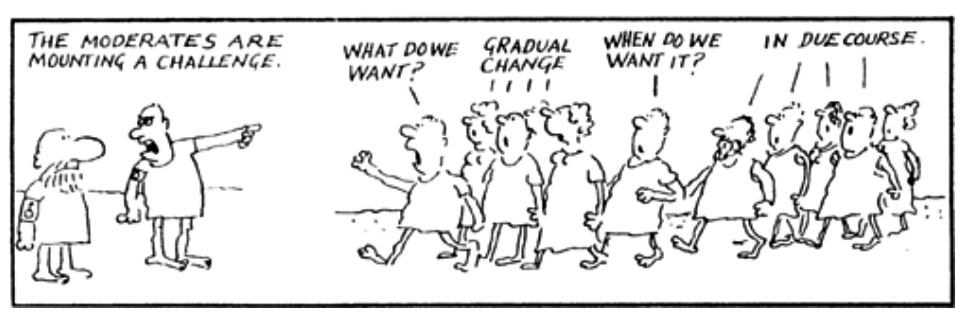
I think the College has needed an opposition more than it has needed an extra person to join a committee. It seems that once someone joins up, they have to sign some promise not to speak openly. All debates are thus one-sided, between mutes on the inside and fellows on Auspsyc and similar places on the outside. Small wonder that the College has a PR problem.
4) That being said, I have recently put my name forward as a candidate for the Membership Engagement Committee. I'm not holding my breath. I imagine my prospects depend, to paraphrase LBJ, on whether the Board would rather have me on the inside of the tent pissing out, or the outside, pissing in.
5) When much of what goes on in the College is opaque to the fellowship, it is easy to join dots up incorrectly, because half the story is invisible. Granted that, it still looks to me as though you ran your philosophy of working constructively from inside to reform the College towards direct elections from 1986 until about 2010. The effort failed twice. Fourteen years of patient effort with not a lot to show for it.
In about 2010, several rude, noisy malcontents from Auspsyc, including myself, got involved in the debate. It revved up. In December the Auspsyc poll showed 89% wanted direct elections, and 2% (one voter) trusted the College to sort the problems out. You don't have to reply, but I always suspected the single voter was you.
During 2011, direct elections were still off the menu. The Governance Matters report polled huge majorities in favour of direct elections, yet under the instructions they were given to conduct a poll, but 'say what you think without reference to the poll'. They recommended no direct elections.
Further critical comment from me and others was intensified. Your letter (6.2.12): 'Comment on the College’s review of General Council/College governance', was particularly helpful.
Eventually the President was persuaded (by people of whom some were probably insiders) that she wouldn't get the 75% vote to change the Constitution if the draft opposed the wishes of 89% who favoured direct elections. The College ran a poll on the direct election issue which showed 79% of the wider fellowship in favour of direct elections. This was confirmed with 93% voting for the new Constitution including direct elections.
My thesis is that polite insider work didn't pull it off alone. But a coalition of polite insiders plus noisy critical activists did pull it off together.
I would be interested to know whether you find that plausible.
I suspect than one mechanism is that shouting from the street outside committee meetings tends to empower voices of reform, democracy and ethics inside the meeting. Voices that might otherwise be silenced.
6) Another matter. I think both you and I want to reform the College, but that we see different strategies for doing it. You believe in Strategy A (being constructive from within). I believe in a combination of Strategy A, and Strategy B (critical opposition including humour from without.)
But I also have another agenda entirely.
I am trying to change the paradigm of participation in the College.
Let me explain.
The old paradigm of participation involves something like this:
a) Finish work. Drive through traffic to the somewhere in a capital city. Sit for two hours while agenda items are worked through. Drive through traffic to go home. It attracts a disproportionate number of public and academic psychiatrists who can persuade their employers that their role in the College deserves to be called paid work. It attracts people more easily for whom the home fires are not particularly warm. It attracts people especially from a radius of less than an hours drive around the meeting place. It involves a myth, largely believed exclusively by people who attend such meetings. They believe in something called a 'State Branch'. There is, of course, no such animal. There are 'Capital City branches' commonly populated by people who believe they represent psychiatrists outside the capital city. This paradigm struggles with the 'Tyranny of Distance'.
b) The new paradigm, which I support, is based on the internet. It involves participation at an entirely different level. I am sure you know what I mean, since you are also one of the 'elders' of Auspsyc.
I gave a talk about these two paradigms at the Gold Coast Congress in April 2007
http://www.youtube.com/watch?v=ydtKD2fayZA
Part of my hesitancy about following your advice to shut up and work constructively from inside, is that I suspect that will prop up the paradigm I am trying to replace.
Kind regards,
David
On 08/05/2013, at 2:43 AM, John Buchanan <johnbuchanan1@...> wrote:
Hi David, must make a comment on your comment about my comment!
You extoll the virtues of mockery about things you do not agree with,
especially regulations in the College.
Mockery is OK as far as goes, but the trouble is that is does not go very
far at all - it does not change anything!
All medical colleges and other organizations must have regulations on all
manner of things: entry criteria to be a member, professional standards,
limits to spending, authority for Committee Chairs and staff, and ...
election conduct.
My first point is that although the criteria for conduct of an election may
need to change (I understand they were deliberately set at a conservative
level) all candidates are required to follow the current guidelines, what
ever they are at the time- this is collegial behaviour, in the same way
that following the spending limits for a committee chair is collegial
behaviour (rather than spending excessively on dinners and alcohol and
expecting the college to pick up the tab, for example, as has happened in
the past).
The time for change in election conduct criteria has to be after the event
as flaws are revealed (although I too would have preferred somewhat more
liberal criteria in the first instance on this occasion).
My second point is that the best way to change things in a professional
body is not mockery from outside while refraining from constructive
contribution, but to be involved in Sections, Branches, committees for this
or that of personal interest, and have constructive input from within.
This is actually how the democratic change we are now beginning to
experience has in fact come about! While not perfect, it is moving in the
appropriate direction for a professional body in the 21st C.
I am certainly not recommending-blind obedience to authority -as you put it.
One can have influence by knowing the players, meeting people at College
events, and making a contribution to the life of the organization. .Any
College Fellow can make submissions and suggestions, which may have more
influence in how things change than may be appreciated, and I put the view
that it is more effective in producing change than mockery!
It would be good if more Fellows would make constructive suggestions into
the appropriate place in College processes, rather than just moan outside.
The College decision-makers and staff are different now from those whose
authoritarian behaviour to Fellows about twenty years ago made me angry
enough to get involved myself. Some people behave as if those people are
still in charge, but they are not. We have a new Board, new EO's, new
staff, new attitudes.
So, what about more Fellows directing their constructive suggestions about
electoral procedure to College Executive (soon to be Board) and the CEO,
rather than expending their energy on external mockery? It might just give
a better outcome.
cheers
John Buchanan
|
| Principles for future College elections |
|
| Posted By: |
|
Sun May 12, 2013 8:35 am | |
|
|
|
Hi list,
There is widespread agreement that College Election 1.01 was a fiasco. It was an opportunity for healing that was badly fluffed. Instead of reconciliation and increased legitimacy of our representatives, we have been left with more fear and loathing than ever.
So, is it yet time to start discussing College Election 1.02?
I won't be at the Congress. I am hoping that some sort of Truth and Reconciliation meeting, such as that proposed to be chaired by John Buchanan, with participation by main actors will occur.
If I had been at such a meeting, I would have proposed the following:
1) What are we trying to achieve?
a) Maximum voter participation. Make voting much simpler.
b) Clarity in the electorate about the qualities and policies of the different candidates.
c) Confidence that the result is not tampered with.
d) The launching of the successful candidates as symbols of unification and genuine representativeness of the Fellowship.
2) The President.
a) What do we want our President to do? I think an important part of their role is to be able to be a public spokesperson for organised psychiatry in Australia and New Zealand. They should be able to effectively handle the media, and present our case to the public in such a way that elicits a sympathetic response. Their behaviour in public should have the effect of reducing the fear and stigma associated with psychiatrists. In certain TV political debates, there is the device of the 'worm' which turns up or down depending on what a candidate says. We should have a worm to show the effect of our president appearing on TV. A good presidential performance would be followed by an increase in the number of new appointments with psychiatrists by people who have never seen one before. 'Oh, if that's what a psychiatrist is like, perhaps I will go and see one'.
b) From this it follows that, far from video being illegal in the campaign, it should be compulsory for the Presidential candidate to put up a video showing how telegenic they are. There might also be a panel discussion between the candidates and, say, a journalist, at which we might get an idea how our potential presidents might handle public controversy, interviews etc.
3) The Directors.
a) In this latest election, the candidates were all identified by the state they come from. Why? Why not gender, public/private, sexual preference, religion, Shiite/Sunni, AFL/League supporter or whatever. I agree with Bob Hawke that the State level of government in Australia is redundant, and we would be much better off with two levels of government rather than three. But by labelling candidates by state, and then severely restricting what we can know about them, a pattern of tribal allegiance is set up that produces the sort of problem that bedevils countries in Africa and the Middle East, where the president of a country is seen as the representative of a particular tribe that has captured the presidency.
You can see evidence of this in some of the transferable voting patterns. When Philip Morris (Qld) lost his position as top candidate, most of his votes flowed to David Alcorn (Qld) who had previously been outside the top five.
I don't particularly care whether the president comes from Waikikamookau or Back of Bourke. What I do care is whether a candidate is Fellowphilic or Fellowphobic.
b) As someone else (Rob Shields?) said, our representatives need to be IT savvy enough to enable them to communicate successfully with those of us outside the capital city beltways. Let them produce websites with links to their writings, photos, policies and everything. And let the College website provide links to these websites. The RACP does that; no great mayhem appears to result from it.
4) The Australian Election Company was engaged to do the count. It seems like a good idea to have the election process handled by an independent body. It gives confidence in the impartiality of the election. But the point is lost entirely if the AEC is used as a fig-leaf to cover up manipulation of the result by an anonymous 'complaint' that is acted on without due process or right of appeal.
A similar exercise in phony 'going through the motions' occurred with Governance Matters. An independent consultancy was asked to poll the fellows for their opinions and then totally ignore them when making their recommendations! The AEC was put up as an independent election manager, but then the result they produced was changed by dodgy fiat.
In the May 1968 Paris student riots there was a poster:
Je participe
Tu participes
Il participe
Nous participons
Vous participez
Ils décident.
Future College elections should be fair dinkum.
As a participant in the recent debate, I cannot be a historian. But because it is easy for the record to get lost in an email list with multiple previous repeated copies etc, I have assembled a compilation of emails about the election between early March and now. They are mostly from me, but anyone who wanted an overview of what has unfolded might find it helpful to have them all in one place.
http://psyberspace.com.au/articles/election.htm
Yours
David |
